Urban Agriculture: Defined
Urban farming involves the cultivation, processing, and distribution of agricultural products, both food or non-food.1 It happens when spaces in the urban areas are utilized to plant crops for various uses.
When animal products are also produced, this process is now called Urban Agriculture. The Department of Agriculture – Agricultural Training Institute defines urban agriculture as the “process of growing, processing, and distribution of food crops and animal products, by and for the local community, within an urban environment.” 2
Urban Agriculture has various production strategies such as edible landscaping, container gardening, vertical gardening, hydroponics, aquaponics, and aeroponics. All of these strategies can be done in small idle spaces in urban areas given the proper materials and equipment to start farming.
The Pandemic Effect: Home Gardening and Community Pantries
During the height of the pandemic, people had a hard time accessing markets and grocery stores due to the strict barangay lockdowns. This brought community pantries to life where people would be able to have access to produce in their very own communities without the need to travel far.
Those who have spaces at home have turned to gardening as a hobby. Some started with ornamental plants like succulents or monstera to pass time. Others tried their hand in planting seeds they got from the vegetables they ate at home. They were able to produce herbs and vegetables that they can use as additional ingredients to their meals. As long as there is sun, soil, water, and someone that is willing to take time to tend to the plants’ needs, the earth will give back to its caretaker.
For some gardeners, drums and big pipes helped them create vertical tower gardens where they are able to produce vegetables. Aquaponics, on the other hand, enabled people to produce plants and grow fishes at the same time. Giving not only greens or vegetables, but also fish for food.
Aside from the emergence of personal gardens and mini-farms in the urban setting, the government has also intensified its efforts to push for urban agriculture as an aid to the problems of food accessibility.
Urban Farming Initiatives
Community gardens in local government units (LGU) like the “Joy of Urban Farming” Initiative by the Quezon City (QC) LGU3or the urban farm initiative of Homeless People’s Federation in Payatas4 are being supported by the government5 as it is seen to help food security in their communities.
These efforts by the QC LGU have enabled them to reach 1,026 urban farms in their various communities. This involved giving tax exemptions for idle lands when owners would utilize these lands for urban agriculture. This has also provided livelihood opportunities for 25,000 urban farmers in the city. Thus, idle lands are utilized and people with farming skills are also given opportunities to work.
Schools are also urged to follow the Gulayan sa Paaralan Program (GPP) where teachers, staff, and students will create spaces where vegetables can be grown and later be used for the schools’ feeding program and as possible income generation for schools.
All of these initiatives hope to use available spaces in the LGUs and schools to raise crops that could provide sustenance for the children and the community.
Move To Change’s Role in Aiding to Food Security
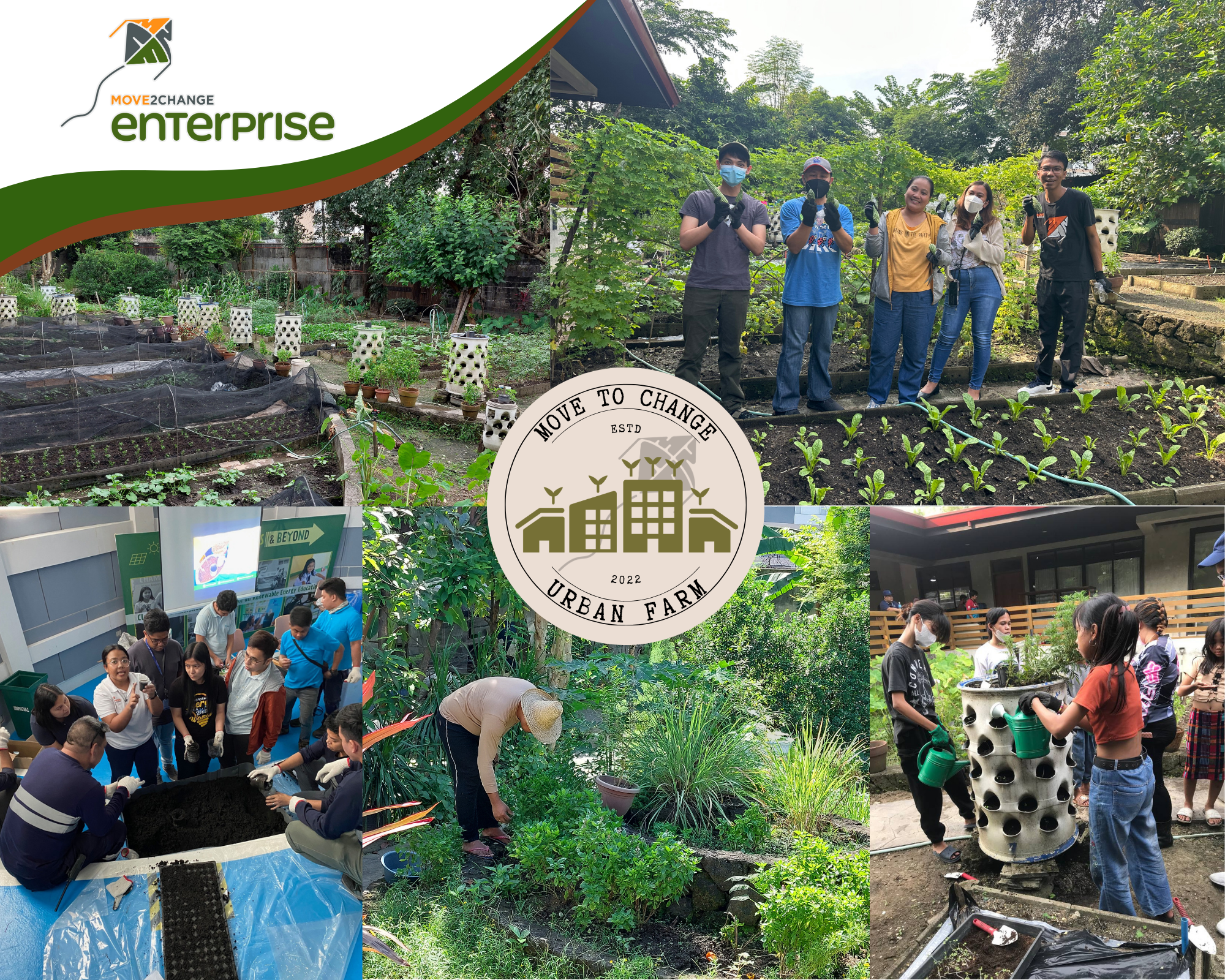
Move to Change Foundation, Inc. as an organization also hopes to aid in the country’s growing food insecurity. Through its Urban Farm in the heart of San Juan City, members and partners of Move to Change are learning the best practices of urban farming.
As we learn to take better care of our Urban Farm, we also get first-hand experiences of best practices that we can include in our farming training to teach others how to start food production at home or in their office spaces.
This sharing of knowledge does not just revolve on the actual farming itself. We also aim to raise awareness on the state of agriculture in the country.
We hope to create more people who are skilled in producing food that may also aid in producing food for their families and their communities.
Other past programs of Move to Change involved advocating for the youth to be more involved in agriculture through the Youth 4 Agri Campaign and the push for people to try out farming through our Volunteers’ Farm Day.
If you are interested in learning more about our Urban Farm programs and trainings: you may email us at: urbanfarm@movetochange.org
Together, let us plant seeds for a country where no one gets hungry. Let us be equipped to be self-sustaining by learning to produce food in our communities.#
-Written by April Grace Garcia (Team Member: CSP and Social Media)
– Guided by Mark Lee Babaran (Urban Farm Prime Mover)
References: